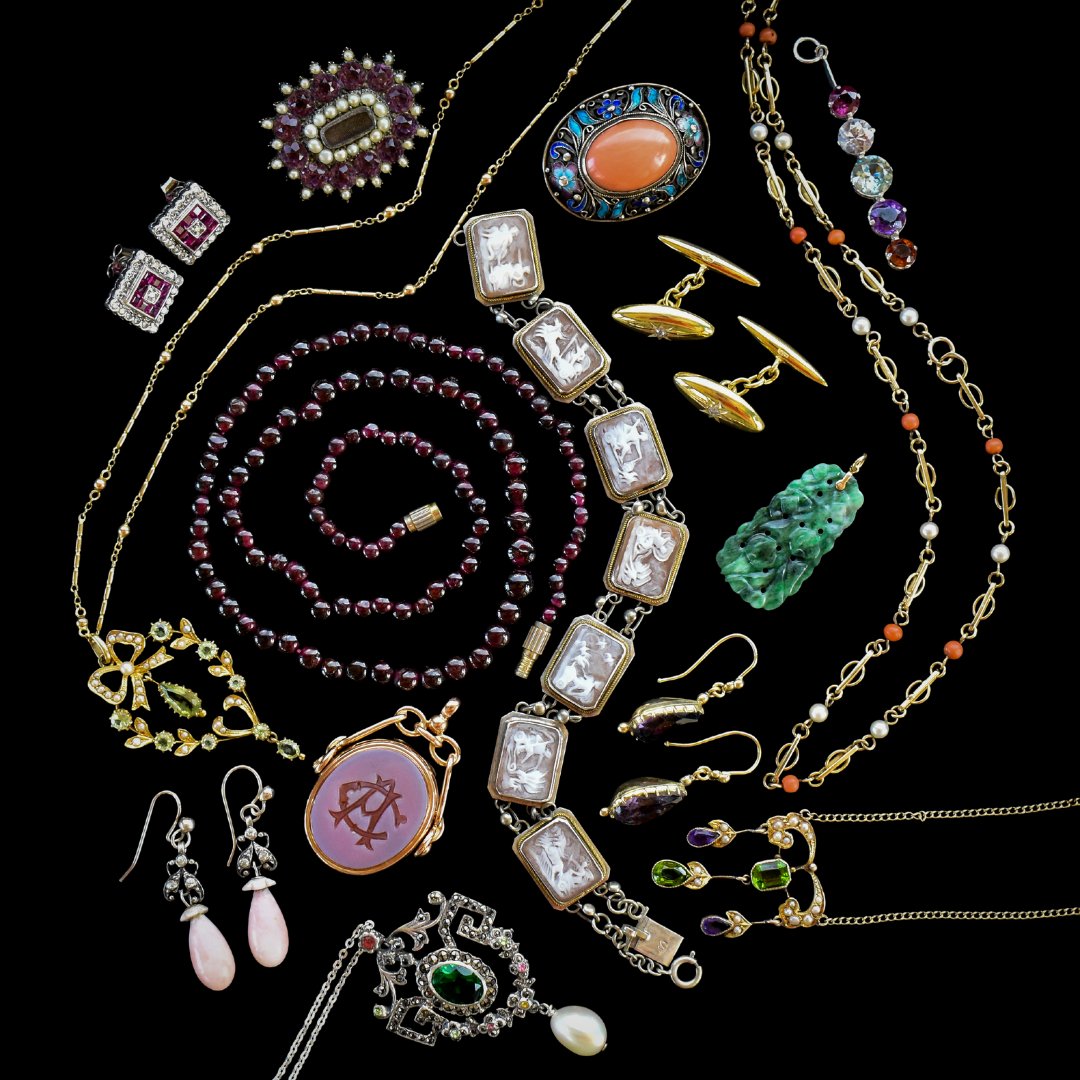


Many of our antique jewellery pieces come in gold, and a common question we get asked is ‘What type of gold is this?’, and perhaps more importantly, ‘What do the different types mean?’ You may have seen terms such as 9ct and 24k when describing jewellery metals, but it can be confusing to understand how they affect the pieces you’re buying.
This is our ultimate guide to gold purity. We’re breaking down all the different types and what they actually mean for your vintage jewellery purchases.
What is Gold Purity?
Before going through the different carats of gold, it’s worth diving into what gold purity is.
Gold purity refers to the percentage of pure gold in a metal mixture (an alloy). The higher the carat number, the more pure gold there is in the metal. 24k, or 24-carat, is pure gold; any other measurements refer to parts out of 24. So, when you hear 18-carat gold, 18 parts of the metal are gold, and 6 are other metals.
Where it gets confusing is when terms like gold-plated, gold-filled, and solid gold get thrown around. The gold we’re focusing on in this article (and the gold typically used in antique pieces) is solid gold.
Solid Gold: Made from entirely gold metal in various carats with no base metal core. The whole piece is made from this one metal, even if it’s, say, 10-carat and has 14 parts of other metals mixed in. This does not fade or tarnish and is the most expensive.
Gold-Filled: Real gold is bonded to a base metal such as brass. The gold must make up at least 5% of the total weight of the item. This is also very tarnish-resistant and will last for a few decades with proper care before the base metal begins to show. If you see hallmarks like 1/20 14K GF or 14/20 GF this means that 1/20 of the item’s total weight is 14-carat gold.
Gold-Plated: A base metal such as copper, brass, or nickel is dipped into an extremely thin layer of gold. This is the least durable option, as the thin layer wears down quickly when exposed to sweat, water, and oxygen.
To help us work out the metal used in a piece - and to spot fake gold jewellery - we use a Niton DXL XRF analyser, which tells us the exact material.
With vintage pieces, if they contain copper, this reacts naturally with oxygen over time in a period called oxidation, which can often cause pieces such as rose gold jewellery to develop a dark patina. Patinas aren’t necessarily anything to worry about, and can give pieces the distinct ‘antique’ appearance.

9ct Gold Purity
9-carat gold is typically the lowest number you’ll see for pure gold jewellery, as it is the lowest legal standard for gold jewellery in the UK.
This type is made from 37.5% pure gold and 62.5% alloy, making it the most affordable variation whilst still having the durability of a pure gold piece.
9ct gold has been the UK standard since 1854, so you’ll often find this metal used in later Victorian and Edwardian pieces.
The standard hallmark for 9ct gold is 375, which stands for the 37.5% of gold.
Many of our Albert chains are crafted from 9ct gold. This would’ve been a piece worn daily, so it needed durability and everyday wear resistance, but was significantly more affordable than 24-carat gold, making it popular with the Victorian middle-class audience.
10ct Gold Purity
In the USA, 10ct gold is the lowest legal purity level, and it contains 41.7% gold and 58.3% other metals, which makes it a very popular base option in North American markets. It’s similar to 9ct gold in its durability and affordability in comparison to higher levels of gold purity.
The hallmark for this is 417, but you may also find stampings of 10K or 10CT on your antique piece.
14ct Gold Purity
14ct gold is 58.5% pure gold, and 41.5% other metals, and it uses the 585 hallmark.
This gold is a modern standard across the US and Europe, but is less common in UK-made pieces. It’s the common ground between 9ct and 18ct, and has a richer and warm yellow colour than 9ct.
Before 1932, we used 12ct and 15ct gold standards in the UK, but this was abolished and replaced by 14ct as standard. This means that if you see pieces marked as 12ct or 15ct, it’s quite often made before 1932, making it a hidden treasure that almost certainly guarantees your piece is antique.
18ct Gold Purity
18ct gold has 75% purity, marked with a 750 hallmark in historic British hallmarking. It was often the choice for Georgian and Victorian fine jewellery due to its luxurious look and a deep gold tone.
Many antique engagement rings are made from 18ct gold due to its high durability and high value. Rings made from this metal truly stand the test of time and are regularly chosen by engaged couples wanting a piece with both a story to tell and durability.
22ct & 24ct Gold Purity
The high standard when it comes to gold purity. 22 carat gold is 91.6% pure, and of course 24 carat gold is 100% pure gold, making them the most costly choices of the bunch.
These types of gold are actually quite rare to find in antique pieces, as high-carat gold is actually quite soft and lacks structural strength. Where vintage jewellery has intricate designs or sophisticated prongs to hold a gemstone, gold of a high-carat does not have the grip to hold these in place. South Asian and Middle Eastern pieces actually favour this type of gold for jewellery, so vintage pieces made from these metals may be from these markets originally.
Today, 22ct gold is the standard for British wedding bands, and 24ct gold is really only used for gold bars due to its softness.

How Do I Test Gold Purity?
Now that we’ve identified the different types, the question remains of how to identify which gold jewellery pieces are which.
At Lancastrian Jewellers, we put the gold purity in each product listing, clearly stating if the piece is gold-filled or plated at all.
But if you have jewellery at home and want to see its worth, there are a few ways to test:
- Hallmarks: As we’ve mentioned, the simplest way is to look for tiny stamp markings with numbers like 10ct or 585, relating to either the carat number or purity percentage.
- Density Testing: Weigh your item using a digital scale. Then, place the item in a graduated container filled with water to measure its water displacement in millilitres. You then divide the weight by the volume, pure gold should measure around 19.3g/ml, and 18ct gold is around 15g/ml.
- At-Home Testing Kit: There are at-home gold acid testing kits that include a touchstone and specific carat acids to test gold purities at home.
With any of these methods, it is advised to get pieces tested by a jeweller to avoid confusion between gold-filled or plated pieces.
If you have antique gold jewellery lying around at home, you can sell it with us at Lancastrian Jewellers. We’ll give your piece an evaluation and offer a competitive price for your jewellery.


